The global lab-grown diamond jewelry market has experienced explosive growth over the past five years, reshaping retail jewelry economics and redefining consumer expectations for fine diamond jewelry. As a professional lab created diamond jewellery manufacturer, we have partnered with thousands of independent jewelers, boutique retailers, and e-commerce jewelry sellers worldwide. One of the most frequently asked questions from our B2B clients revolves around sustainable, scalable, and industry-standard profit margins for reselling finished diamond rings. Unlike mined diamond jewelry with rigid, brand-controlled pricing systems, modern lab-grown diamond rings offer flexible markup potential, low inventory risks, and high customer conversion rates. This article breaks down the complete operational logic behind profitable ring resale, covering core cost composition, tiered markup standards, professional retail ring pricing rules, and actionable strategies to stabilize and boost lab diamond resale profit for all types of retail jewelry businesses.
Complete Breakdown of Lab Ring Cost Structure for Retailers
To calculate accurate profit margins and avoid blind pricing, every jewelry retailer must master the full lab ring cost structure, which extends far beyond the basic wholesale purchase price. Many new retailers mistakenly calculate profit solely based on supplier invoice costs, ignoring hidden operational expenses that ultimately erode net earnings. A comprehensive cost system includes three core components, all of which determine the final reasonable markup range for retail sales.
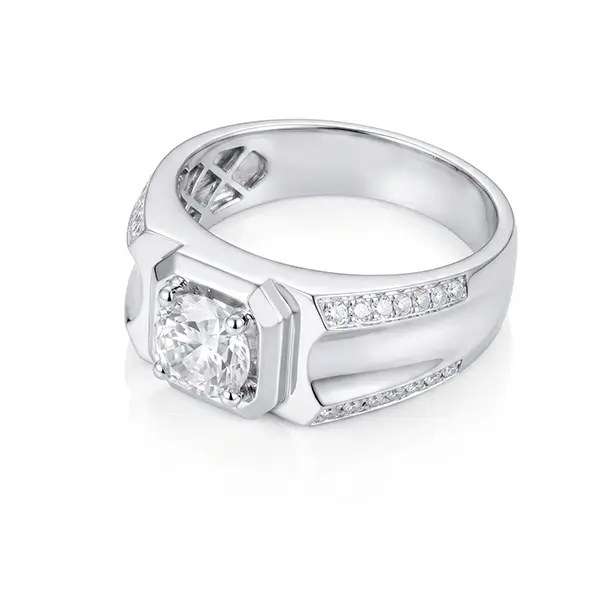
First is the core product wholesale cost, referring to the factory direct price of wholesale lab grown diamond rings. This cost covers polished certified lab-grown diamonds with complete 4C grading standards, precision metal settings in 925 silver, 10K, 14K, and 18K gold, professional inlay craftsmanship, and basic factory finishing and quality inspection. As a manufacturer, we optimize production costs through large-scale batch production, advanced CVD and HPHT growth technology, and automated setting processes, enabling retailers to access high-quality finished rings at 60% to 80% lower costs than equivalent mined diamond rings.
Second is landing and sourcing overhead costs. These include international shipping fees, customs clearance charges, import duties, product insurance, and batch re-inspection fees after goods arrive at the retailer’s warehouse. For cross-border resellers, these variable costs typically account for 5% to 12% of the base wholesale price, varying by order volume and logistics methods. Bulk order buyers can effectively reduce unit landing costs and expand profit space through freight sharing and tariff optimization.
Third is daily retail operating costs, the most easily overlooked part of profit calculation. This category covers physical store rent and utility bills, e-commerce platform commission fees, payment processing charges, product shooting and graphic design costs, marketing and social media promotion expenses, labor salaries, customized packaging, after-sales maintenance, return and exchange loss reserves, and inventory capital occupation costs. Only by deducting all these expenses from gross profit can retailers obtain real net profit margins.
Industry Standard Wholesale Jewelry Markup Benchmarks by Price Tier
Reasonable wholesale jewelry markup is not a fixed multiple across all products. Based on decades of manufacturing and B2B service experience, we have summarized tiered markup rules tailored to different price segments of finished lab-grown diamond rings, which align with global retail market competition and consumer price sensitivity. These tiered standards help retailers balance sales volume, market competitiveness, and profit stability, avoiding the common mistake of unified markup for all products.
Entry-level wholesale lab grown diamond rings with a factory cost range of $200 to $800 focus on lightweight carat stones, simple solitaire settings, and silver or 10K gold bands, mainly targeting daily wear and gift-giving consumer groups. This segment features fierce market competition and high customer price sensitivity, relying on high sales volume to generate stable profits. The recommended retail markup multiple is 1.8× to 2.4× the landing wholesale cost, delivering a gross margin of 44% to 58% and a final net margin of 15% to 25% after deducting operating expenses. For online mass-market retailers, adhering to the lower end of the markup range ensures high conversion rates and quick inventory turnover.
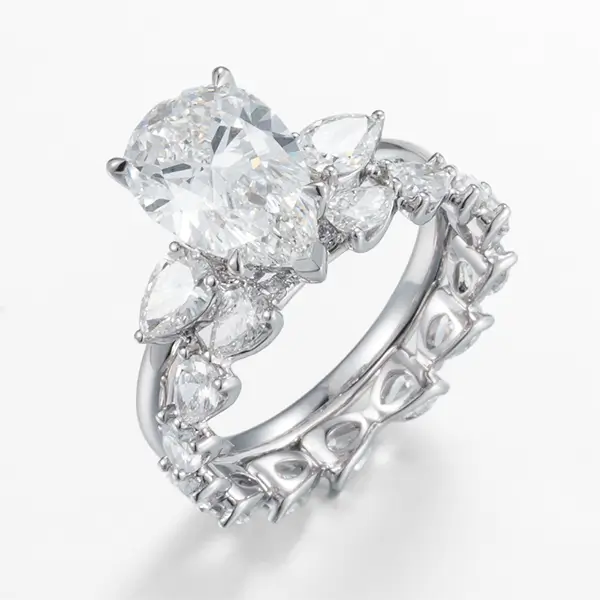
Mid-tier rings with wholesale costs between $800 and $3000 are the core profit source for most physical and online jewelers. This segment includes mainstream 0.8ct to 2ct round brilliant lab-grown diamonds, classic halo designs, and durable 14K solid gold settings, covering mainstream engagement and wedding ring market demand. Consumer groups in this tier pay equal attention to product quality, design and cost performance, with moderate price sensitivity. The industry standard markup multiple is 1.6× to 2.0×, bringing a gross margin of 38% to 50% and a net margin of 12% to 20%. Stable quality and consistent product grading from manufacturers help retailers maintain standardized pricing and stable profits in this mainstream segment.
High-end premium rings with wholesale costs above $3000 cover 2ct and above large carat stones, fancy cut and fancy color lab-grown diamonds, and high-precision 18K gold inlaid luxury settings. These products require large capital investment, have slow inventory turnover, and bear higher market and inventory risks. To balance capital occupation and profit returns, the reasonable markup multiple is controlled at 1.4× to 1.7×, with a gross margin of 28% to 41% and a net margin of 10% to 16%. High-end product profits rely on brand trust, professional after-sales services and differentiated design advantages rather than blind high markup.
Key Factors Influencing Jeweler Ring Margins in Actual Operation
Jeweler ring margins are not solely determined by product cost and markup multiples; multiple market and operational factors will significantly adjust final profit levels. As a professional manufacturer, we remind retail partners to flexibly adjust pricing strategies according to their own business scenarios to maximize profit potential.
Order volume and procurement cycle are the foundational factors affecting profit space. Long-term stable bulk procurement allows manufacturers to provide exclusive discounted wholesale prices, reducing retailers’ unit landing costs and directly increasing profit margins. In contrast, small-batch trial orders and sporadic replenishments carry higher unit costs, compressing markup space. We support customized batch procurement plans for different retailers to help them optimize cost control based on business scale.
Sales channel differences bring obvious profit gaps. Physical boutique jewelers bear higher rent, labor and offline service costs, so they can implement higher-end markup strategies supported by in-store experience, professional fitting and one-on-one consulting services. Pure online e-commerce stores face transparent price comparisons and fierce homogeneous competition, so they need to adopt moderate markup and rely on volume growth to maintain total profits. Social media live streaming and short-video sales channels can appropriately increase service-added markup by virtue of content marketing and trust building.
Product differentiation and service upgrades are core ways to expand profit margins. Ordinary conventional solitaire rings face serious price involution, while customized rings with exclusive engraving, personalized size adjustment, vintage improved settings, and certified full grading reports can break price competition and achieve premium pricing. Meanwhile, value-added services such as lifetime maintenance, free resizing, and formal warranty services can effectively justify higher retail prices and improve customer repurchase rates without increasing too much operating cost.
Scientific Retail Pricing Strategies to Maximize Long-Term Resale Profit
To obtain sustainable lab diamond resale profit, retailers need to abandon arbitrary pricing and adopt systematic, data-supported pricing strategies combining cost accounting, market competition and value positioning. Combined with manufacturer-side industry data and retail terminal feedback, we summarize three practical pricing strategies suitable for lab-grown diamond ring resale.
First is accurate cost-plus pricing, the most basic and stable pricing method. Retailers must calculate the total landing cost including wholesale price, logistics and auxiliary expenses, instead of simply using factory wholesale price as the cost base. On this basis, apply the tiered markup multiple corresponding to the product price segment to ensure basic gross profit space and avoid profit losses caused by neglected hidden costs.
Second is competitive market alignment pricing. Retailers need to regularly monitor the pricing of peer products with the same carat, cut, color, clarity and setting material, and keep their own prices within a reasonable market fluctuation range. Excessively high pricing will lead to lost customers, while excessive low-price dumping will disrupt the local market profit system and trigger malignant price competition, which is not conducive to long-term business operation.
Third is value-based premium pricing for differentiated products. For high-quality wholesale lab grown diamond rings with official certification, unique design and complete after-sales support, retailers can position products in the high-cost performance track different from low-end homogeneous products. Consumers are willing to pay premium prices for guaranteed quality, reliable services and shopping experience, which effectively improves overall profit margins.
Common Pricing Pitfalls and Optimization Solutions
In our long-term B2B cooperation, we find that many retailers fail to achieve expected profit margins due to standardized wrong pricing logic. The first common pitfall is unified markup for all product segments. Applying high markup multiples to high-value large-carats rings will make products lose market competitiveness, while using low markup for entry-level products will waste profit space and lead to low overall profit margins.
The second pitfall is confusing gross margin with net profit. Many new retailers only focus on gross markup income but ignore continuous operating expenses such as platform fees, marketing investment and inventory depreciation, resulting in actual net profit far lower than expected. The solution is to establish a complete profit accounting system and deduct fixed and variable operating costs in real time.
The third pitfall is excessive dependent on discount promotions. Frequent large-scale price reductions will reduce product value in consumers’ perception, making customers form the habit of waiting for discounts. This will squeeze long-term profit margins and damage brand positioning. Retailers should replace blind discounts with limited-time preferential activities, package sales and value-added service gifts to maintain stable pricing systems.
With the technical maturity oflab created diamond jewellery manufacturer and the continuous improvement of industrial chain efficiency, retailers can obtain stable cost advantages and flexible pricing space. By thoroughly sorting out the complete lab ring cost structure, abiding by scientific wholesale jewelry markup standards, adapting retail ring pricing rules according to sales channels, and avoiding common operational pitfalls, jewelers can effectively stabilize jeweler ring margins and achieve sustainable growth of lab diamond resale profit.